
VIDEO HEAD IMPULSE TESTING
WHAT IS VIDEO HEAD IMPULSE TESTING?
Video Head Impulse Testing allows us to gain critical insight into the workings of your vestibular system. The vestibular system consists of the inner ear vestibular receptors and the vestibular nerves. It also includes the brainstem, cerebellar and brain structures that process inner ear input. It is one of the key mechanisms by which we determine where we are in space. It allows us to make sense of our relationship with gravity and head motion, and compare that with feedback from the eyes and the body. This allows us to localize ourselves in the world.
There are several functional parts to the vestibular system, including the six semicircular canals. These canals act as sensors to detect head motion and head position. They provide input that the brain uses to fire core stabilizing muscles. They work with the brainstem and cerebellum to generate vestibulo-ocular reflexes. These help us stabilize our gaze and know where the visual world is as our head moves. Problems with these reflexes often lead to dizziness and vertigo. Damage to these reflexes is extremely common in concussions and traumatic brain injuries, and functional imbalances in these systems can be involved in everything from movement disorders and neurodegenerative diseases to psychiatric conditions. VHIT testing allows us to precisely quantify the function and fatigability of all six vestibular canals and their associated reflexes. This is another critical part of your unique NeuroRescue program.
HOW DOES VHIT HELP ME?
Video head impulse testing helps us determine the function of your vestibular system, which is the foundation input that your brain uses to make sense of where you are in the world. The six semicircular canal reflexes are critically involved in creating your brain’s unconscious concept of where your head is in space and how it is moving. Your brain uses this input to help localize your body in the environment, and to choose the appropriate stabilization strategies to control your muscles. If this unconscious concept of where the body is localized is wrong, the body fires the wrong stabilization reflexes, leading to balance difficulty and injury. When a mismatch exists between vestibular inputs and those from the eyes and body, the result is usually dizziness and vertigo. Impaired vestibular canals and associated reflexes can be involved in all manner of neurological conditions, including:
Dizziness & Vertigo | Traumatic Brain Injuries & Concussions | Movement Disorders | Headaches & Migraines | Balance Disorders | Anxiety & Depression | Cognitive Difficulties | Neurodegenerative Disorders | Neurodevelopmental Disorders
WHAT TO EXPECT:
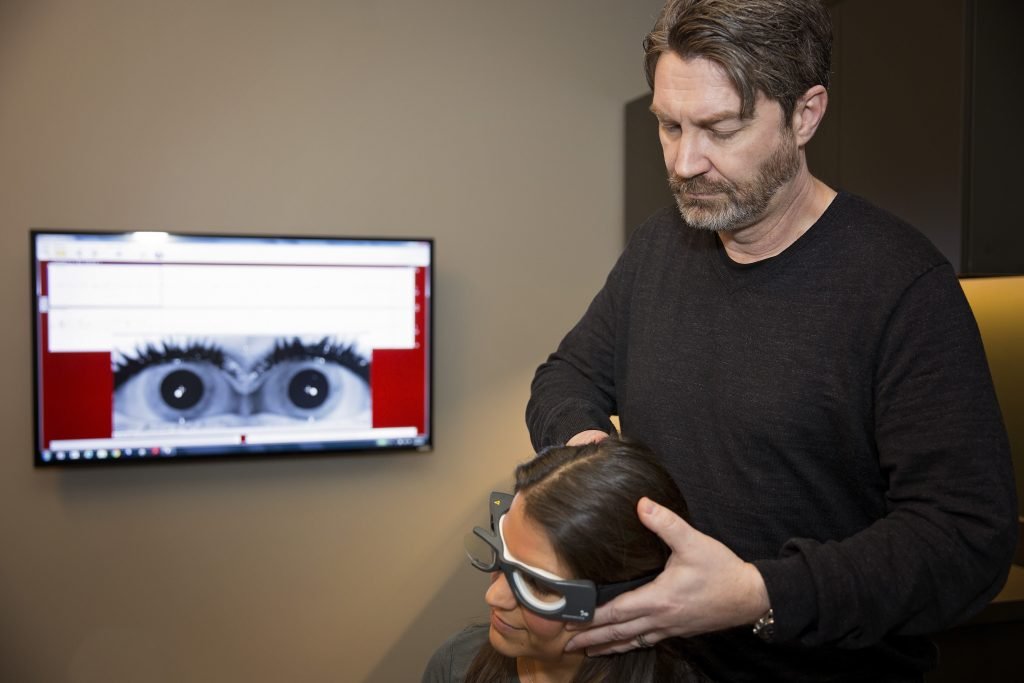
VHIT testing involves having you wear a set of lightweight goggles while a technician moves your head in different directions. The goggles contain an accelerometer that measures your head movement, and an infrared camera that tracks your pupil. You sit up straight and focus on a target on the wall, while your technician moves your head through a series of ranges of motion with quick head impulses. As your head moves, you activate specific vestibulo-ocular reflexes that move the eyes generally in the opposite direction.
The computer tracks your eye movement, compares it with the head movement, and quantifies the function of the reflex. It evaluates the reflex gain, the relationship between head movement and eye movement, and outputs both a numerical score and a graphical representation of the reflex. We can use this data to see how well these reflexes are working, analyze their symmetry, and design precise rehabilitation strategies to get them all working well and together again.
FAQs
-
Yes. VHIT testing is extremely safe and comfortable. Before we begin the test, your technician will evaluate the range of motion of your neck to ensure that you can perform the test without any discomfort.
In some circumstances of neck injury or advanced spinal degeneration, this test may not be appropriate. Your provider will determine during your initial history if it is safe for you to perform VHIT testing.
-
The vestibular pathways can be impaired in all sorts of different ways. These can range from viral infections that affect the receptors or vestibular nerve, to tiny inner ear crystals that become dislodged and settle in the semicircular canals where they do not belong. Vestibular reflexes are very commonly affected by concussions and traumatic brain injuries. In many cases problems with these reflexes can be present from birth.
-
No. VHIT testing is very comfortable, and generally does not provoke any symptoms.
-
VHIT testing shows us the function of all six of your vestibular semicircular canal reflexes. It shows us their individual gains and the symmetry between the various paired canal systems. It gives us insight about how well your brain understands where your head is in space in various positions and planes of movement. It shows us if your brain is capable of generating the correct eye movement to keep your eyes on target when your head moves. It shows us if it understands how to fire muscles from your ankles all the way up to your neck to stabilize your body and prevent you from falling or injuring yourself when you move your head.
The inputs from your vestibular system are about much more than just your ability to balance. Vestibular problems have been implicated in everything from cognitive and emotional regulation issues to chronic pain states. Addressing vestibular problems is one of the core tenets of your NeuroRescue Program.
-
Yes. We focus heavily on vestibular function in all of our NeuroRescue Programs. Vestibular rehabilitation one of the most foundational things we do. Our approach to vestibular rehabilitation is significantly different from conventional vestibular therapy. Traditional vestibular rehab is usually something called Habituation Therapy. Habituation therapy is essentially neurological “tough love,” in that vestibular challenges are identified that provoke dizziness and associated symptoms. You are then asked to perform these provocative tasks over an over until your brain learns to compensate for the impaired reflex by substituting another neurological reflex. For example, if you turn your head to the left, and an impaired vestibular reflex fails to move your eyes far enough to the right, it may provoke dizziness and nausea. You are then tasked with performing the provocative movement until your cerebellum and frontal lobe learn to move your eyes using a different mechanism whenever it senses your head moving to the left. This movement will keep provoking your symptoms until the brain learns how to move the eyes properly.
This is not really fixing the problem, but rather is only training your brain to compensate for the impaired reflex. Compensation strategies can be helpful for a time, but if anything changes in your vestibular system in the future, these compensations can create as many problems as they solve.
Our approach to vestibular rehabilitation is significantly different. We begin by precisely quantifying exactly which reflexes are impaired using all of our neurodiagnostic technologies. We then find ways to directly activate the reflexes involved using a host of different therapies, in order to restore as much function of the damaged reflex as possible. Once we have the impaired reflexes working better, we employ strategies to integrate them with other visual and proprioceptive responses to get everything working in concert again.
Only then do we return to the provocative tasks that were creating your symptoms, at which point the impact on your system is usually far more manageable. We find that this approach is not only more effective, but also far more comfortable, and provokes fewer symptoms. There are some circumstances where we do still need to build compensations, but these are less frequent and tend to be exceptions rather than the rule.
LET’S GET YOU BACK TO LIVING YOUR BEST LIFE
“I’m very very thankful that I came here. It is the only place that I went to out of all of them that had the answers that I needed.”
-
We use advanced neurodiagnostic technologies and cutting edge neurorehabilitation strategies that are unique to your brain and condition.
-
We use high frequency treatment over 5-10 days, to bring you maximum results in the shortest time possible.